During my time at the University of Mary Washington I participated in undergraduate research under Dr. Pamela Grothe using corals as paleoclimate proxies. I used the geochemistry of corals , both δ18O and Sr/Ca, to understand and analyze how corals record past climate especially El Nino Southern Oscillation events.
Below is my abstract that has been accepted to AGU Ocean Sciences 2026 meeting in Glasgow, Scotland:
Investigating the viability of coral species Dipsastraea speciosa and Hydnophora microconos as reliable archives of central tropical Pacific climate change using Sr/Ca and δ18O
Calleigh E. Keeley, Edmund E. Gable, Jessica F. Oberlies, Pamela R. Grothe, Ainsley Lord, Kelly H. Kilbourne, Chandler A. Morris, Kim M. Cobb
Sr/Ca and δ18O data from coral skeletal material provide historical records of climate where instrumental records are nonexistent. In the central tropical Pacific (CTP), paleoclimate records rely on Porites sp., due to their fast growth rate, dense skeletal structure, and concentric growth bands. However, the spatial and temporal distribution of Porites corals can be a limiting factor in paleoclimate reconstruction in the CTP, a region heavily influenced by El Niño Southern Oscillation. Work with large skeletal architectural corals in the Caribbean suggests that similar types of corals in the CTP may be used as recorders of climate, providing an expanded archive of coral genera used for paleoclimate reconstruction. Both Dipsastraea speciosa and Hydnophora microconos were collected from the reef on Kiritimati Island (1.8°N, 157.4°W). The δ18O and Sr/Ca of the coral skeletal material were analyzed along the main growth axis and compared with instrumental sea surface temperature (SST) and sea surface salinity (SSS) data. First, samples were taken from different features of the coral skeleton, the thecal wall and the septal tissue, to determine if geochemical differences exist in different parts of the skeletal material. Results suggest that in Dipsastraea s., the δ18O of the thecal wall produces a more reliable timeseries of SST than the septal material. Then, we compared duplicate Sr/Ca and δ18O time series in single corals of Dipsastraea s. and Hydnophora m. as well as across multiple coral colonies. We find consistent variability in δ18O timeseries in both Dipsastraea s. and Hydnophora m.. However, Sr/Ca timeseries show more variability, both in the single coral and multi-coral reproducibility tests, suggesting the incorporation of Sr and Ca is more sensitive based on the type of skeletal material. We conclude that Dipsastraea s. and Hydnophora m. may be used as paleoclimate proxies if sampling is carefully limited to the densest skeletal feature.
AGU Ocean Sciences 2026 Poster
I created this poster highlighting the Sr/Ca results for both DS and HM corals and co-presented it with my colleague at the AGU conference.
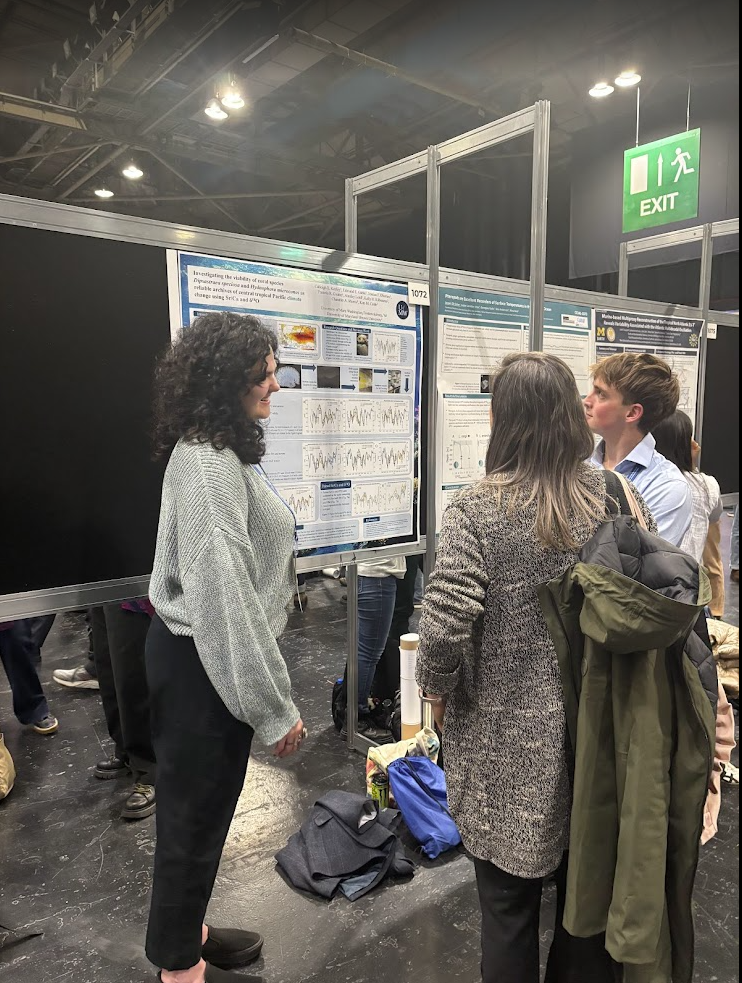
My colleague and I presenting the poster I created at the AGU Meeting during our poster session.
Some Images and Videos of Sampling:
Timelapse video of me sampling for Sr/Ca at the University of Maryland Chesapeake Bay Research Site.
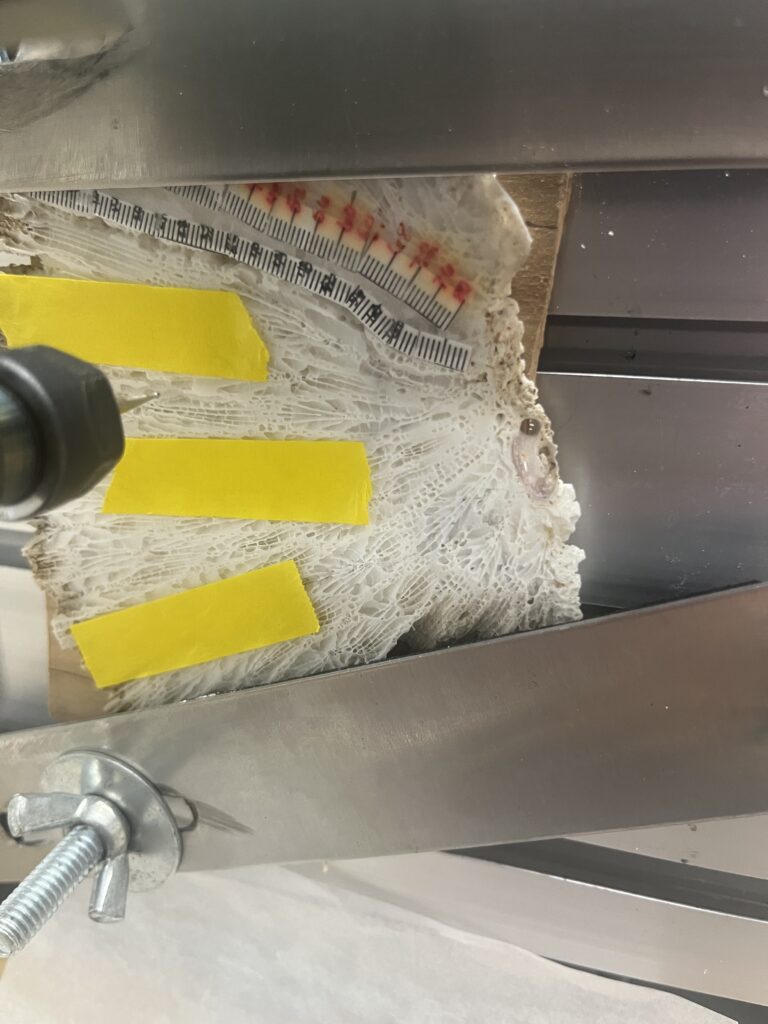
Image of Dipsastraea S. prepared for sampling Sr/Ca.